
A coalition of leading civil rights and advocacy organizations condemned the Hudson Institute for hosting Dattatreya Hosabale, General Secretary of India’s Rashtriya Swayamsevak Sangh (RSS), at its Washington, DC headquarters on April 23, 2026. The event featured a solo fireside chat with Walter Russell Mead, the institute’s Ravenel B. Curry III Distinguished Fellow.
The event took place just weeks after the U.S. Commission on International Religious Freedom (USCIRF) released its 2026 Annual Report on March 4, 2026. In a significant and unprecedented step, USCIRF recommended that the U.S. State Department consider sanctions on the RSS, including asset freezes and visa restrictions. The report cited the organization’s alleged “responsibility for and tolerance of severe violations of religious freedom.”
The coalition stated that the decision to platform RSS leaders at Hudson’s April 23 India Conference raises serious concerns not only about human rights, but also about U.S. national security, citing the organization’s links to a broader political ecosystem under increasing scrutiny for alleged transnational repression activities in North America.
“This is not just about a single, isolated event. It reflects a broader pattern of platforming, legitimizing, and amplifying ideologies that have been linked to violence, discrimination, and the erosion of democratic values. At its core, it raises the question of whether our institutions uphold pluralism, accountability, and human rights in their partnerships, public engagement, and the vetting of speakers,” said Safa Ahmed, Executive Director of IMAM.
The coalition further noted that the RSS serves as the ideological core of a broader network that has been widely documented as contributing to violence and discrimination against religious minorities, including Muslims and Christians. It also referenced the organization’s historical links to the extremist milieu associated with Nathuram Godse, the assassin of Mahatma Gandhi.
Additionally, the coalition pointed to recent cases raising concerns about transnational repression:
- In February 2026, Nikhil Gupta, an Indian national in U.S. custody, pleaded guilty in a federal case involving a murder-for-hire plot targeting a U.S. citizen, which prosecutors alleged was directed by an Indian government official.
- Canadian authorities have also publicly alleged that individuals linked to the same political ecosystem have been involved in acts including killings, arson, and extortion on Canadian soil.
“At a time when credible allegations of state-linked violence have extended beyond national borders, institutions like Hudson must exercise far greater responsibility in whom they choose to legitimize,” the coalition added.
The coalition emphasized that think tanks such as the Hudson Institute play a critical role in shaping U.S. foreign policy discourse, informing lawmakers, and influencing public understanding of global issues. Providing a platform to actors associated with documented patterns of rights violations and emerging national security concerns risks undermining those very objectives.
The coalition called on the Hudson Institute to reconsider its decision and urged policymakers, media, and civil society leaders to critically examine the implications of engaging with organizations and individuals linked to religious persecution and transnational repression.
Call On Institutions and Policymakers To:
- Adopt stronger vetting standards for speakers, partners, and affiliated organizations
- Ensure transparency around institutional partnerships and foreign influence concerns
- Center human rights and religious freedom in public events and policy engagement
- Reject the normalization of exclusionary and extremist ideologies
- Protect inclusive civic spaces for all communities
Help Build Momentum
Please share this campaign. The more people who see this campaign, the stronger our collective voice becomes.
About RSS
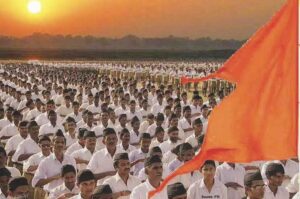
The Rashtriya Swayamsevak Sangh (RSS) is a paramilitary organization founded in 1925, influenced by European fascist movements, a period that also saw Adolf Hitler publish Mein Kampf and establish the SS. Its co-founder, B. S. Moonje, traveled to Italy in 1931 to study Benito Mussolini’s fascist institutions and later described the RSS as an Indian equivalent of such models. Its second Sarsanghchalak (Supreme Chief), M. S. Golwalkar, wrote in 1939 in praise of Nazi Germany’s treatment of Jews, describing it as “race pride manifested at its highest” and “a good lesson for us in Hindustan to learn and profit by.”
In a 1947 letter to provincial governors, Jawaharlal Nehru described the RSS as “a private army… proceeding on the strictest Nazi lines, even following the techniques of that organization.” The RSS’s religious affiliate, the Vishva Hindu Parishad (VHP), was classified as a “militant religious organization” in the CIA World Factbook in June 2018, a designation reportedly removed weeks later following pressure from the organization.
Independent India banned the RSS three times:
- 1948, following the assassination of Mahatma Gandhi by an individual with past links to the organization
- 1975, during the Emergency
- 1992, after the demolition of the Babri Masjid by its cadres, which triggered riots that killed more than 2,000 Muslims
Human rights reporting and journalistic investigations have linked RSS-affiliated networks to episodes of large-scale communal violence, including the 2002 Gujarat violence and unrest in Manipur beginning in 2023, as well as incidents of mob lynchings and attacks on religious minorities across India.
In interviews conducted between 2012 and 2014 with The Caravan magazine, RSS member Swami Aseemanand—then accused in connection with multiple bombings that killed scores of Muslims, alleged that current RSS chief Mohan Bhagwat had prior knowledge of or sanctioned such attacks. According to Aseemanand, Bhagwat stated: “It’s very important that it be done. But you should not link it to the Sangh.”
The cumulative impact of these events has resulted in significant loss of life. Victims include those killed directly in acts attributed to individuals and groups linked to this network, as well as those affected by broader patterns of violence and policies associated with the political ecosystem in which the RSS operates.